
SICK CM30-16BAP-KW1 Capacitive Proximity Sensor
1. Product Overview
The SICK CM30-16BAP-KW1 is a capacitive proximity sensor designed to detect the presence of objects without physical contact. Capacitive sensing technology can detect both metallic and non-metallic materials, depending on the material and sensing conditions.
It is suitable for industrial automation tasks such as object detection, material monitoring and level detection. Its non-contact operation supports reliable sensing in applications where mechanical contact with the target should be avoided.
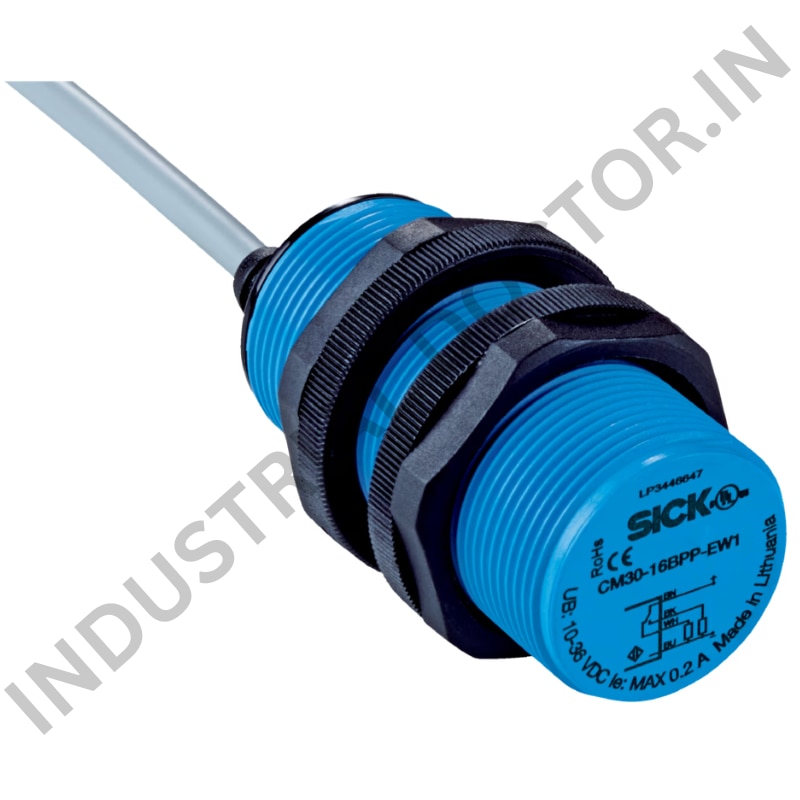
2. Key Features
Capacitive sensing technology for non-contact detection.
Metal and non-metal detection, depending on the target material and setup.
Industrial automation support for machine and process monitoring.
Contactless operation to reduce mechanical wear.
Versatile applications for detecting solids, liquids and other suitable materials.
Reliable object monitoring when installed and configured correctly.
3. Applications
Factory automation and production lines.
Detection of plastic, glass, paper and other suitable non-metallic objects.
Material presence monitoring in packaging machines.
Level detection for suitable materials in tanks and containers.
Object detection in assembly and handling systems.
Industrial process monitoring and machine control.
4. Why Choose SICK CM30-16BAP-KW1?
Non-contact detection: Detects target presence without direct mechanical contact.
Adjustable sensitivity: The integrated potentiometer allows sensitivity adjustment.
Rugged protection: IP67 enclosure rating supports use in demanding industrial environments.
Flexible installation: M30 × 1.5 threaded housing with flush mounting.
Wide AC supply range: Supports 20–250 V AC, offering flexibility for compatible industrial systems.
5. Technical Specifications
Specification | Details |
|---|---|
Brand | SICK |
Model | CM30-16BAP-KW1 |
Part number | 6028411 |
Sensor type | Capacitive proximity sensor |
Housing diameter | 30 mm |
Thread size | M30 × 1.5 |
Sensing range | 2–16 mm |
Safe sensing range | 11.52 mm |
Installation type | Flush |
Switching frequency | 10 Hz |
Supply voltage | 20–250 V AC |
Output function | Normally open (NO) or normally closed (NC) |
Electrical connection | 2-wire AC |
Cable length | 2 m |
Sensitivity adjustment | 11-turn potentiometer |
Protection rating | IP67 |
Housing material | Plastic (PBT) |
Operating temperature | −25°C to +80°C |
Specifications are based on the manufacturer's datasheet and may be subject to change.
6. SICK CM30-16BAP-KW1 Supplier in India
For purchasing the SICK CM30-16BAP-KW1 capacitive proximity sensor in India, buyers can check product availability, pricing, delivery timelines and warranty terms with industrial automation suppliers.
Before ordering, confirm the model number, part number 6028411, required quantity and compatibility with your machine's AC electrical circuit.
7. Frequently Asked Questions – CM30-16BAP-KW1
Q1. What is the SICK CM30-16BAP-KW1 used for?
It is used for non-contact proximity detection and material presence monitoring in industrial automation systems.
Q2. What materials can this sensor detect?
Capacitive sensors can detect metallic and non-metallic materials, including suitable plastics, glass, liquids and other materials. Detection distance varies by target material and installation.
Q3. What is its maximum sensing range?
Its specified sensing range is 2–16 mm. The safe sensing range is 11.52 mm.
Q4. Can it operate in wet or dusty environments?
Its IP67 rating provides protection against dust ingress and temporary immersion under specified test conditions. Installation instructions must still be followed.
Q5. Does it operate on DC power?
No. This model uses a 20–250 V AC, 2-wire connection. Confirm electrical compatibility before installation.
Q6. How is the sensing sensitivity adjusted?
Sensitivity is adjusted using the integrated 11-turn potentiometer, following the manufacturer's operating instructions.
Q7. What is the advantage of capacitive sensing?
It enables detection without physical contact and can sense a wider range of material types than inductive sensors, which primarily detect metal.